Mediterranean Beef Stew In Wine Sauce
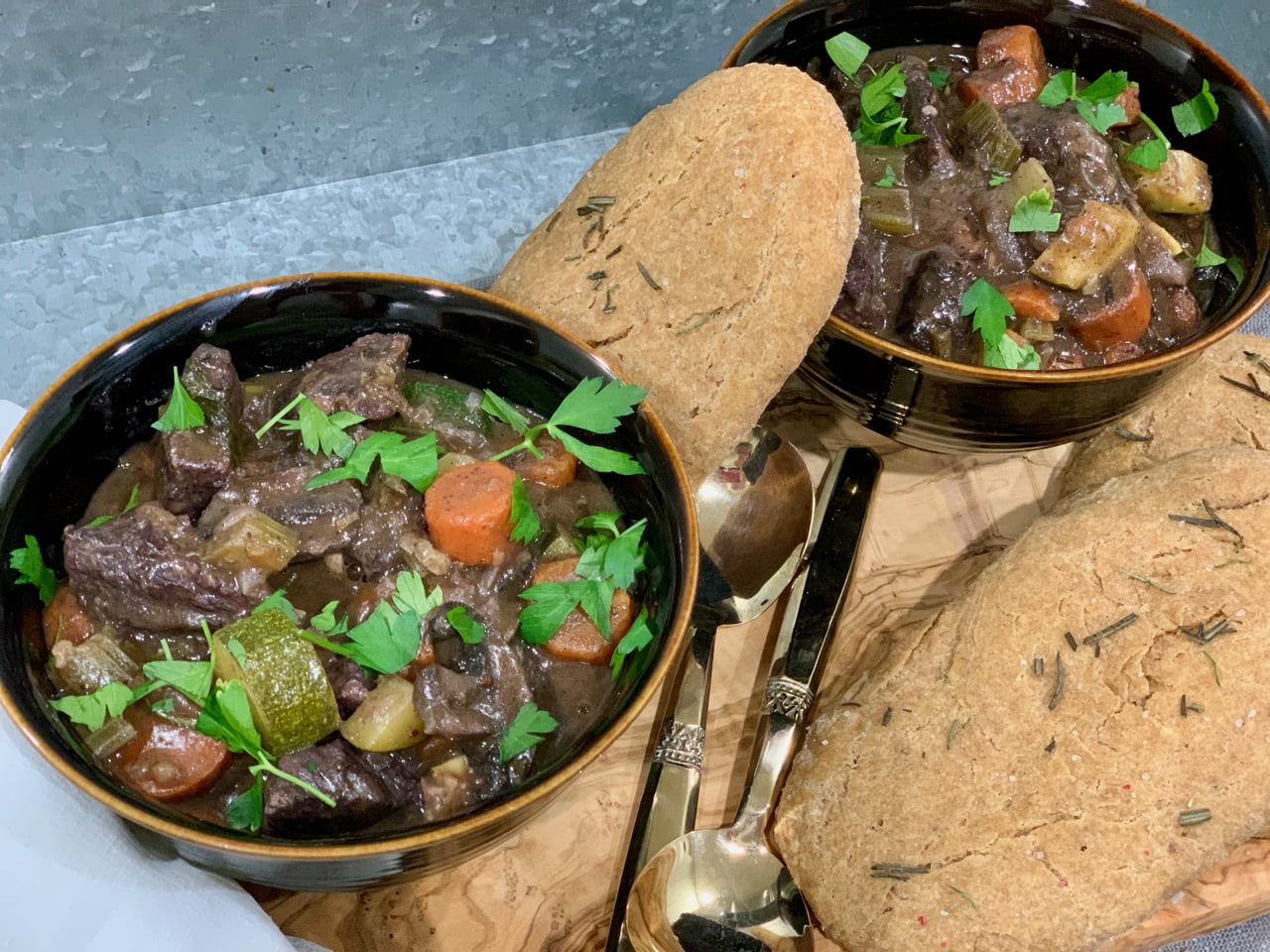
Mediterranean Beef Stew In Wine Sauce is a substantial dish consisting of tender beef pieces cooked in a robust wine sauce infused with spices, herbs, and a spelt roux.
A Cozy Mediterranean Beef Stew
This wintry Mediterranean beef stew emphasizes patience, texture, and the selection of ingredients that become increasingly generous over time.
As the stew cooks, the red wine concentrates, the aromatics mellow, and the beef transforms into a spoon-tender, profoundly comforting dish.
Beef Stew
Beef stew, or any meat stew, is an excellent method to utilize budget-friendly cuts of meat, which are often the least tender, and transform them into something extraordinarily tender through prolonged cooking in a flavorful sauce.
Melting some of the fat to incorporate into the sauce significantly heightens flavor and moisture. I prefer to place the fat into a hot skillet with a touch of butter while sautéing the onions, then discard the fat.
Beginning the stew with this foundational step establishes a flavor base that I will enhance as each component is added.
Even though the cubes of beef have had some fat trimmed away, as no one wants to encounter a chewy piece of fat, we still desire its richness!
Mediterranean Stew
Some of the earliest stews known to history were documented (in Biblical texts), from the Mediterranean areas of the globe.
Layers of herbs and spices meld into these stews over time.
Typically, a goat, hare, or if fortunate, segments of a lamb were added to the pot for special occasions.
Added to the pot, was an abundant variety of herbs and vegetables, simmered for hours over an open flame.
My personal favorite, and one of the most sought-after Mediterranean stews made today, is the Tajine.
In a ceramic pot or dish, featuring a cone-shaped lid with a steam vent at the top, a stew is simmered on the stove at low heat.
I believe the slow cooker was inspired by the design of a Tajine clay pot, but what do I really know…
Ancient Stews Of The Mediterranean
The steam vent atop the Tajine lid is intended to permit steam to escape, thus reducing liquid in the sauce and thickening it into a sumptuous gravy.
In my view, this represented an ancient Mediterranean method for thickening a stew, long before the French introduced the ‘roux’!
Mediterranean Spiced Lamb Tajine with Apricots is the Tajine (also spelled Tagine) that I frequently prepare for family and friends.
It exemplifies an ancient technique that is challenging to replicate in contemporary cooking.
Stew
Wine Sugar As It Is Utilized To Soften Meat
Cooking fruit alongside meats is a Mediterranean method for softening the meat through the sugar particles found in the fruit.
This method provides a harmony of sweetness to the savory, occasionally hot or spicy dishes.
I believe that wine, with its sugar content, performs similarly, while also adding flavor and acidity to the sauce.
Preparing Stews With Wine
As noted earlier, simmering meats and fruits together in a savory, sometimes spicy dish is a technique I learned growing up. Wine… naturally, is a fruit!
In this delectable Mediterranean beef stew, the only liquid I incorporated, as all components simmered, was half a bottle of red wine.
I opted for red wine because I was cooking with a red meat. The wine aided in intensifying, enhancing, and revealing the flavors of the ingredients as they combined into one dish.
When preparing with a lighter meat, such as turkey, chicken, or rabbit, I tend to use a dry white wine, ensuring the fragile color of the meat isn’t tainted, which would happen if I used red wine.
Most years, during the holidays, I make it a custom to prepare Rabbit In Wine, which I find amplifies the flavor of the mushrooms, onions, and other components that pair beautifully with the delicate rabbit meat.
As this red wine beef stew cooks low and slow, the alcohol cooks off, allowing the flavors to deepen.
As it reduces, the broth thickens into a stock, just awaiting a dash of roux to add the finishing touch, transforming what might resemble a soup into a stew.
How To Prepare Mediterranean Red Wine Sauce Beef Stew
Once the meat is trimmed of excess fat (keeping the fat for flavor), the vegetables are peeled and cut into sizes and shapes that match the beef chunks.
The layering of flavors then starts, after the meat has been seared to retain its natural juices and flavors.
Rendering the fat with a touch of butter, while caramelizing the onions, is where the flavors first start to emerge.
Remove the fat and incorporate the meat, vegetables, and spices. Gently lift and fold the ingredients at the bottom of the pan to the top several times to ensure all components have ample time at the bottom to develop flavors as well as extract juices.
Pour in the wine, bring to a gentle boil, then reduce the heat and let it simmer with the lid on (slightly ajar, allowing a small amount of steam to escape), and cook for over an hour.
Red Wine Sauce
When the stew has diminished its liquids, and the meat and vegetables are rich in color and tender, a roux is prepared and added to the stew.
It will thicken rapidly and be ready to serve.
Roux is simply a small amount of butter and flour melted together in a separate small pan. Then some liquid from the hot stew is incorporated into the roux mixture until a thick, rich sauce is formed.
The roux mixture is then added to the stew to thicken the remaining liquid.
This method results in a rich red wine sauce for this delightful beef stew.
What To Accompany Mediterranean Beef Stew?
First… Definitely Not potatoes! Including potatoes in a beef stew is not a Mediterranean style stew. It may be found in American, Irish, English, or German cuisines but not Mediterranean. Secondly, and traditionally, rice or barley accompanies beef stew.
Most enjoyed,
Here’s the modified content as requested:
yet would be a grains or barley prepared independently, for instance a Moroccan Rice Medley infused with spices and dried fruits, served alongside or beneath. But absolutely not potatoes!
Carbs We Adore As Accompaniments To Our Beef Stew
In certain Mediterranean locales, more towards Italy and some regions of France, you may encounter orzo, or another variant of pasta presented with a beef stew.
More frequently, however, one would find a flat bread accompanying a Mediterranean beef stew.
A flat bread coated with olive oil and dried herbs, such as rosemary or marjoram or fresh parsley. This is what I favor to serve with my Mediterranean beef stew, alongside a glass of wine!
Required Ingredients
Let’s savor this ideal wintry beef stew Whisk and Dine occasion with these rustic, fragrant, and deeply nourishing components.
- Beef – For a wine-braised stew, tougher, well-marbled cuts are your best ally. Beef chuck is perfect; it’s abundant in connective tissue that gradually breaks down throughout a long simmer, becoming exquisitely tender as it absorbs the concentrated wine and spices. Short ribs or shin can also work splendidly, but chuck provides the ideal equilibrium of flavor, texture, and cost-effectiveness.
- Onions, Celery and Carrots – This timeless trio creates the gentle foundation of the stew. Onions dissolve into the sauce, offering sweetness and body, while celery contributes a subtle savory hint. Carrots introduce earthiness and just enough natural sweetness to counterbalance the wine’s acidity.
- Mushrooms – Mushrooms enrich the stew with their meaty, umami depth. As they cook down, they mirror the heartiness of the beef and absorb the wine sauce, making every mouthful feel indulgent and grounding.
- Garlic – Slow-cooked garlic loses its sharpness and transforms into soft and aromatic, infusing warmth throughout the dish instead of standing out.
- Red wine – The essence of the stew. As it reduces, the wine concentrates into a silky sauce that tenderizes the beef and merges all the flavors together. Opt for a dry, drinkable red, nothing extravagant, simply something you’d enjoy in a glass.
- Salt – More than merely seasoning, salt directs the flavors as they evolve, assisting each ingredient in revealing its richness.
- Aleppo pepper – Mild and slightly fruity, Aleppo pepper imparts warmth without overwhelming heat, providing a gentle glow rather than a blaze.
- Black cumin – Earthy and smoky, black cumin introduces an unexpected depth that feels ancient and grounding, embodying a very Mediterranean spirit.
- Sumac – A vibrant, lemony touch that enhances the richness of the stew. Just sufficient to awaken the palate without dominating.
- Rosemary – Resinous and fragrant, rosemary infuses the stew as it simmers, pairing beautifully with beef and wine while conjuring memories of winter kitchens and leisurely Sundays.
- Spelt flour – Employed to lightly dust the beef or to thicken the sauce, spelt flour adds a delicate nuttiness and creates a smooth, cohesive texture without heaviness.
- Butter – Completed with butter, the stew achieves a glossy and luxurious finish, balancing the wine’s acidity and providing the sauce with its final, comforting embrace.
Essential Equipment
This is where the gentle rhythm of cooking emerges, the simple, cherished tools that transform ingredients into something profoundly comforting.
- Stew pot or Dutch oven with a cover – The centerpiece of the kitchen for this dish. A heavy-bottomed stew pot or Dutch oven evenly distributes heat, allowing the beef to brown beautifully and then simmer gently as the wine reduces. The lid retains moisture, facilitating the slow, tender metamorphosis that makes a winter stew so satisfying.
- Small saucepan – Ideal for gently melting butter or warming liquids before they are added to the stew, guaranteeing seamless integration without shocking the pot.
- Cutting board – A robust surface for chopping and preparing vegetables safely and competently, where the meal embarks on its journey.
- Chopping knife – A sharp, dependable knife makes a significant difference. Clean cuts assist vegetables in cooking uniformly and make preparation feel effortless rather than hurried.
- Vegetable peeler – Simple yet essential for swiftly removing carrot skins, preserving flavors clean and textures tender.
- Measuring cup and spoons – Even a rustic stew benefits from balance. These instruments help steer seasoning and spice, ensuring nothing
Feel free to let me know if you need anything else!
- overpowers the fine balance of wine, herbs, and fragrances.
- Timber or Stainless Steel Stirring Spoon – Utilized for mixing, scraping up tasty browned morsels, and gently shifting components without harming the pot. A timber spoon embodies tradition; stainless steel provides accuracy, both are ideal.
- Whisk – Crucial for smoothly incorporating spelt flour into butter or liquid, avoiding lumps and creating a creamy sauce.
- Ladle – Ideal for serving hearty, comforting bowls, ensuring each serving receives its portion of tender beef and flavorful wine sauce.
- Stovetop or burner – The consistent heat source that permits flavors to develop gradually and authentically, turning basic ingredients into a stew designed for sharing.
- 2-2.5 lbs Beef fat trimmed and reserved, meat diced, I used a chuck roast
- 2 Onions diced
- 5 Celery stalks diced
- 8 Large Carrots diced
- 2 cups Mushrooms diced
- 4 Garlic cloves finely minced
- 2 cups Dry Red Wine
- 1 tbsp Salt or to preference
- 1 tbsp Aleppo pepper
- 2 tbsp Black cumin
- 2 tbsp Sumac
- 2 Rosemary sprigs
- 1/4 cup Spelt flour
- 4 tbsp Butter
-
Heat a large stockpot. Incorporate the fat trimmings, 2 tbsp of butter, and the diced onions into the pot. Stir and cook until the onions are caramelized. Remove any fat pieces.
-
Integrate the meat, celery, carrots, mushrooms, garlic, salt, and spices into the caramelized onions. Stir multiple times, allowing the ingredients to touch the bottom of the pot for searing and caramelization.
-
Pour the wine over the mixture in the pot.
Bring to a mild boil. Reduce to a gentle simmer.Cover with the lid, leaving it slightly open to permit steam to escape.
-
Cook for 1 hour.
-
In a small saucepan, melt the remaining 2 tbsp of butter, incorporate the flour, and stir rapidly until the flour combines, creating a roux.
-
Swiftly ladle in one spoonful at a time of broth from the bubbling stew into the roux, whisking as each addition is made (approximately 4 in total). Transfer the roux into the stew and mix it to blend, resulting in a sumptuous wine sauce. Ensure to scrape all remnants from the roux into the stew pot.
-
Let it simmer on low for another 10 minutes. Turn it off and cover completely. The stew is now ready to be served.

Post Comment