Cold Brew Coffee Ratio (The Ultimate Home Brewing Guide)
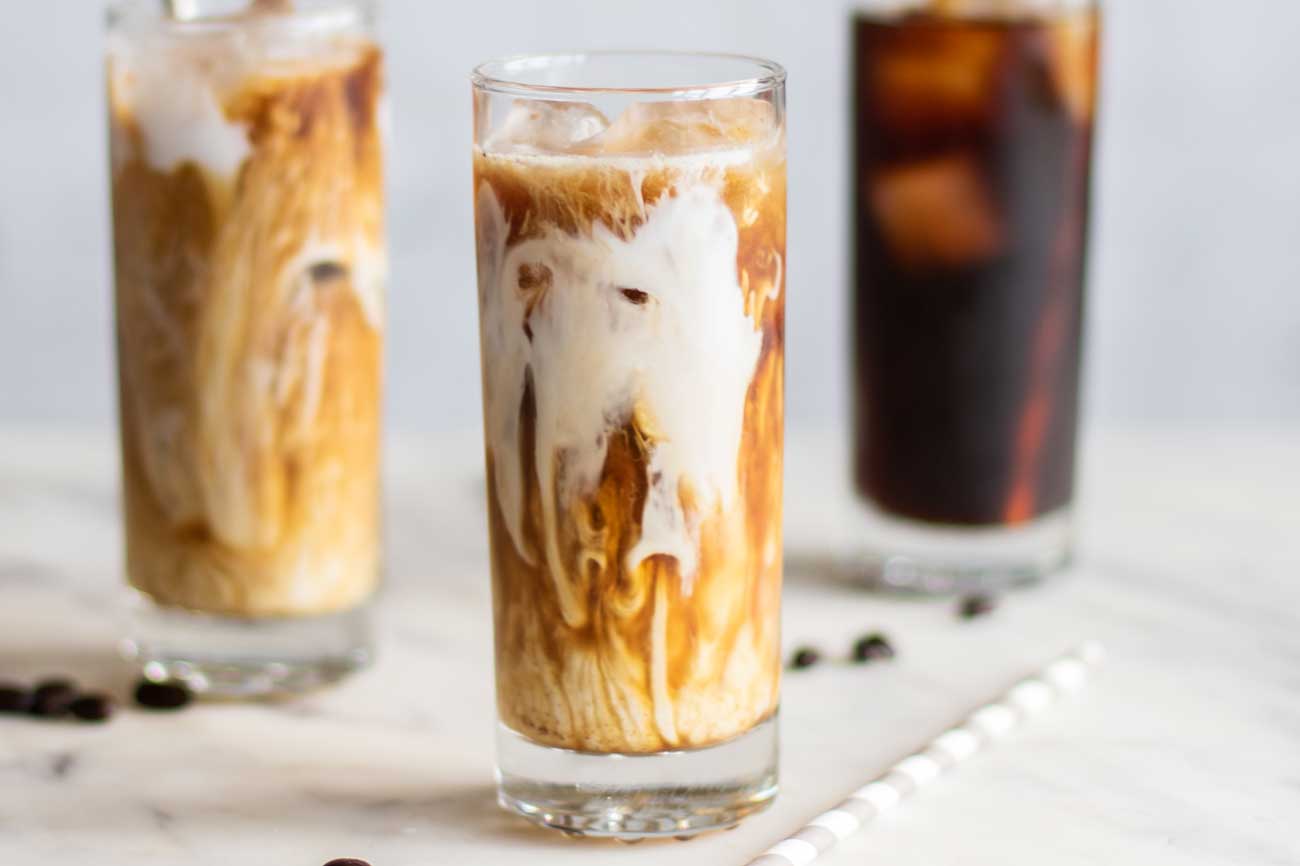
Savor a delightful cold brew coffee this summer while conserving money by avoiding coffee shops. To achieve the ideal glass, the suggested Cold Brew Coffee Ratio is detailed, enabling you to relish your coffee iced, heated, or as a latte. You will discover useful advice on how to create cold brew coffee, ensuring you obtain the perfect brew each time.
Cold Brew vs. Iced Coffee
Cold brew coffee is quite popular at cafes currently! In the summer, it always feels invigorating.
I frequently prepare cold brew at home. It’s quite simple to make, so I prefer to have it readily available when I crave coffee.
Cold brew differs from iced coffee. Iced coffee is merely brewed coffee that has been chilled and then poured over ice. Cold brew coffee is slowly made in cold water, yielding a smoother flavor. While iced coffee must be brewed fresh, cold brew coffee maintains its taste for a week if stored in the refrigerator.
Economize and bypass the café – this cold brew recipe is straightforward to concoct at home! Locate the ideal cold brew coffee ratio for your liking below.
Cold Brew vs. Iced Coffee Insights
- Cold Brew is brewed slowly in cold or room temperature water, instead of being rapidly brewed with hot water.
- Cold brew has a higher caffeine content – cold brew comprises 100-200 mg of caffeine, as opposed to approximately 95 mg in a standard cup of coffee.
- Regular coffee only tastes fresh on the day it’s prepared, while cold brew coffee remains fresh for 5-7 days when kept in the refrigerator.
Decaf Cold Brew Coffee
If you are sensitive to caffeine, it’s very simple to create decaf cold brew coffee. I find that cold brewing decaf enhances its flavor, so it’s an excellent choice if you’re avoiding caffeine, enjoy this later in the day, or simply wish to limit caffeine intake.
My preferred decaf coffee comes from Strictly Organic. This coffee is organic and fair trade certified, making it a fantastic choice for decaf as it utilizes swiss water processing instead of chemicals for decaffeination.
As previously mentioned, cold brew has double the caffeine compared to regular coffee, thus opting for decaf or blending half decaf coffee with standard beans is wise. Ensure you’re utilizing high-quality decaf coffee!
Setting up for cold brew is economical, and many of the items might already be in your kitchen.
1: Burr Grinder
To achieve perfectly ground beans, I suggest using a quality Burr Grinder. A Burr Grinder is the most effective tool to grind beans to a consistent size. It allows you to adjust the grind size, making it suitable for coarser grounds, like those for French Press coffee and cold brew, as well as finely ground beans for espresso and medium-sized grounds for regular drip coffee.
2: A Scale
The secret to having the most flavorful cold brew every time? Weighing your coffee beans! Whether you measure in ounces or grams, this handy food scale is both affordable and precise. Keep it accessible to quickly weigh your beans for the perfect brew.
3: A French Press
You don’t necessarily have to use a French Press for cold brew, but if you make it frequently, I highly recommend it. It’s less messy and simplifies the process compared to using a jar and a cheesecloth (cleaning coffee grounds from cheesecloth is quite tedious!). If you prepare it regularly, it ultimately becomes cheaper since you can reuse it for an extended period.
How to Prepare Cold Brew Coffee
There are two straightforward techniques to cold brew coffee.
Refer to FAQ on cold brew coffee and other brewing methods below.
French Press Method
- Begin with whole bean coffee and coarsely grind the coffee beans in a coffee grinder. It’s optimal to employ a Burr Grinder, which allows you to choose the coarseness of the grounds and yields uniformly sized coffee grounds. This ensures even brewing. The beans should be significantly coarser than standard coffee grinds.
- Introduce the coarsely ground coffee beans into a French press, and add room temperature water. Utilize a long-handled spoon to push the grounds down into the water, then let the coffee steep at room temperature for approximately 12 hours. If you anticipate not getting to the coffee for close to 24 hours, it’s acceptable: Allow the cold brew to steep in the refrigerator to decelerate the brewing process.
- Press the handle on the French press down to separate the coffee grounds, and pour the coffee over ice to relish. Alternatively, pour the coffee into a jar and refrigerate it for up to a week.
Mason Jar Approach for Cold Brew
- To prepare cold brew coffee in a mason jar, coarsely grind coffee beans using a coffee grinder. It’s advisable to utilize a Burr Grinder, allowing you to select the grind size and produce uniformly sized grounds. The beans should be notably coarser than standard coffee grinds. I prefer to see some beans remaining partially intact.
- Add your coarsely ground coffee to a mason jar, then pour in room temperature water. Use a long-handled spoon to press the beans down into the liquid, then permit to “brew” at room temperature for about 12 hours. If you won’t get to the coffee for roughly 24 hours, it’s fine. Make sure the cold brew is steeped in the refrigerator to slow down the brewing process.
- Employ a nut milk bag or cheesecloth to strain out the coffee grounds, and then serve the cold brew coffee over ice for enjoyment.
How Long should Cold Brew Steep?
No matter which method you opt for, cold brew steeps for the same duration.
Steep cold brew for between 16-24 hours.
If you need to extend the steeping period, such as if you’ll be away for a day, refrigerate the cold brew while it’s steeping to decelerate the process, and allow it to steep for up to 48 hours.
Cold Brew Coffee Ratio
The initial attempt I made at preparing cold brew left me quite let down by the diluted beverage I had the following day.
Cold brew coffee demands double the quantity of coffee compared to standard drip brewing.
The cold brew coffee ratio also varies based on your intended use. I generally enjoy my cold brew with just coconut milk as a creamer, served over ice.
You can also warm up cold brew and appreciate it hot, but you’ll require additional water for that, since ice won’t be melting to dilute it.
Another alternative is to create extra strength cold brew and blend it with milk, almond milk, or any other non-dairy milk of your choice to craft a latte or flavored coffee beverage.
- Cold Brew to Pour over Ice: use 1 ounce of coffee beans for every 1 cup of water. Opt for filtered water for the finest taste. I usually prepare 3 cups of coffee, hence I utilize 3 ounces of coffee beans. This is the most prevalent cold brew coffee ratio.
- Cold Brew to Reheat and Savor Hot: Make cold brew as detailed above, using 1 cup of water per 1 ounce of beans, and then incorporate hot water to your liking. To create a milder brew, add 2 parts cold brew coffee with 1 part hot water. For a more intense brew, use a 4:1 ratio.
- Cold Brew Concentrate for Iced Lattes: utilize 3 ounces of coffee beans for 2.5 cups of water. To create a larger batch of cold-brew coffee to have on hand for the week, use 6 ounces of coffee for 5 cups of water.
*3 ounces of coffee beans represents a heaping cup of whole beans.
Cold Brew Ratio in Grams
- Cold Brew to Pour over Ice: use 28 grams of coffee beans for every 1 cup of water (or 85 grams for 3 cups). This is the most common cold brew coffee ratio.
- Cold Brew to Reheat and Savor Hot: Prepare cold brew as indicated above, with 1 cup of water per 28 grams of coffee beans, and subsequently add hot water to your taste.
- Cold Brew Concentrate Ratio for Iced Lattes: use 85 grams of coffee beans per 2.5 cups of water. To prepare a large batch of cold-brew coffee to keep available for the week, employ 170 grams of coffee for 5 cups of water.
Cold Brew Concentrate
Cold brew concentrate is excellent to create if you’re aiming to use coffee as an alternative to espresso in a recipe.
It’s also a wonderful choice if you’d like to indulge in a homemade latte. Follow the ratio mentioned earlier for a more potent coffee, and then combine the cold brew with your preferred milk and serve over ice cubes.
I favor coconut milk for a richer dairy-free latte. Oat milk is quite popular, and traditional dairy milk works fine as well. I find store-bought almond milk too watery for lattes, but this Homemade Vanilla Almond Latte demonstrates how to create a thicker homemade almond milk perfect for iced lattes.
I utilize Cold Brew Concentrate for the subsequent beverages:
- Caramel Mocha Iced Coffee Concentrate
- Coconut Mint Iced Mochas
- Vegan Vanilla Iced Coffees (with homemade cashew milk)
- The Best Vanilla Almond Lattes (these can be appreciated hot or cold, but it’s optimal to start with a cold brew concentrate)
Cold Brew FAQ
Is cold brew stronger than regular coffee?
Indeed, cold brew is more potent than regular coffee. The extended brewing duration permits a greater quantity of coffee to be extracted into the water, yielding a robust coffee that contains more caffeine than standard coffee. This makes it ideal for pouring over ice without diminishing the flavor.
Can cold brew coffee be heated up?
Absolutely, cold brew coffee is excellent when warmed. Simply microwave or heat in a small saucepan, and then dilute with hot water. The recommended ratio for hot coffee is between 2-4 parts cold brew to 1 part hot water (1 cup of cold brew to 1/2 cup of water, or 1 cup of cold brew to 1/4 cup of hot water, based on desired strength).
How long to cold brew coffee?
At room temperature, cold brew requires 12 hours. If you won’t get to it until 24 hours, slow down the brewing by storing it in the refrigerator. If you want to relish it sooner than 12 hours, kick off with hot (not boiling) water, and let it sit for 3-6 hours.
What grind for cold brew coffee?
Cold brew coffee performs best with coarsely ground coffee. You should still observe some whole beans in the coffee. This is for two reasons — firstly, coffee that is ground too fine will yield a gritty coffee after straining, and secondly, the smaller grind size will lead to over-extraction, resulting in excessively strong and bitter coffee.
Can you use pre-ground coffee for cold brew?
It is not advisable to utilize pre-ground coffee. Most coffee establishments will grind your beans for cold brew. However, I did test using pre-ground beans and discovered that, while not optimal, it does function. Two recommendations for using pre-ground coffee are to double strain it to eliminate as many of the grounds as possible, and to brew it with cold rather than room temperature water, and steep it in the refrigerator to slow down the brewing process. Pre-ground coffee should be ready to enjoy in approximately 6-8 hours if left in the refrigerator to brew.
I’d love to connect with you on social media! Find me onFacebookorInstagramwhere I post daily healthy eating and lifestyle inspiration!
Cold Brew Coffee Ratio
Figuring out how you will use your coffee will aid you in determining the optimal cold brew coffee ratio. Cold brew is fantastic poured over ice, used in a latte, or reheated and enjoyed hot.
Print Pin RateServings: 3 cups
Ingredients
Cold Brew Coffee Concentrate
Cold Brew for Enjoying as Hot Coffee*
Instructions
Using a blender or coffee grinder, coarsely crush the beans. Refer to the picture above for the texture. It’s essential to grind the beans coarsely so that the grounds are easy to filter and your coffee remains clear. Ensure all beans are shattered, but remain in significantly larger fragments than you would generally utilize.
Add the coffee grounds to a French press or alternatively, a mason jar. Pour water over the coffee grounds, then utilize a long-handled spoon to stir the grounds into the water. The grounds may float, but ensure they become completely saturated.
Permit the coffee to cold brew in the refrigerator or a cool part of your home for overnight or a maximum of 24 hours.
- If utilizing a French press, simply press down the handle to filter the coffee. grounds, and afterward the coffee is prepared for use. When utilizing a mason jar, I’ve discovered that employing a nut milk bag is the simplest method to swiftly drain the coffee and disconnect the grounds. Cheesecloth is also effective.
Savor the coffee poured over ice, blended with milk for a latte, or reheated as a warm drink.
Notes
-
- Cold Brew for Pouring over Ice: utilize 1 ounce of coffee beans for each 1 cup of water. I usually make 3 cups of coffee, hence I utilize 3 ounces of coffee beans. This is the prevalent cold brew coffee ratio.
-
- Cold Brew to Reheat and Enjoy Hot: Prepare cold brew as mentioned earlier, using 1 cup of water per 1 ounce of beans, and then incorporate hot water to your liking. For a milder brew, mix 2 parts cold brew coffee with 1 part hot water. For a bolder brew, apply a 4:1 ratio.
-
- Cold Brew Concentrate for Iced Lattes: use 3 ounces of coffee beans for 2.5 cups of water. To create additional brew to have on hand throughout the week, apply 6 ounces of coffee to 5 cups of water.
Cold Brew Ratio in Grams
-
- Cold Brew for Pouring over Ice: employ 28 grams of coffee beans for every 1 cup of water (or 85 grams for 3 cups). This is the prevalent cold brew coffee ratio.
-
- Cold Brew to Reheat and Enjoy Hot: Create cold brew as previously described, utilizing 1 cup of water per 28 grams of coffee beans, followed by adding hot water to your preference.
-
- Cold Brew Concentrate Ratio for Iced Lattes: utilize 85 grams of coffee beans for 2.5 cups of water. For preparing extra brew to keep ready for the week, employ 170 grams of coffee to 5 cups of water.
Nutrition
Sodium: 22mg | Calcium: 14mg

Post Comment